Trex's sales jumped. Why did profit barely move?
Revenue rose sharply, but higher delivery and plant costs left net income barely changed. Cash generation also declined from a year earlier.
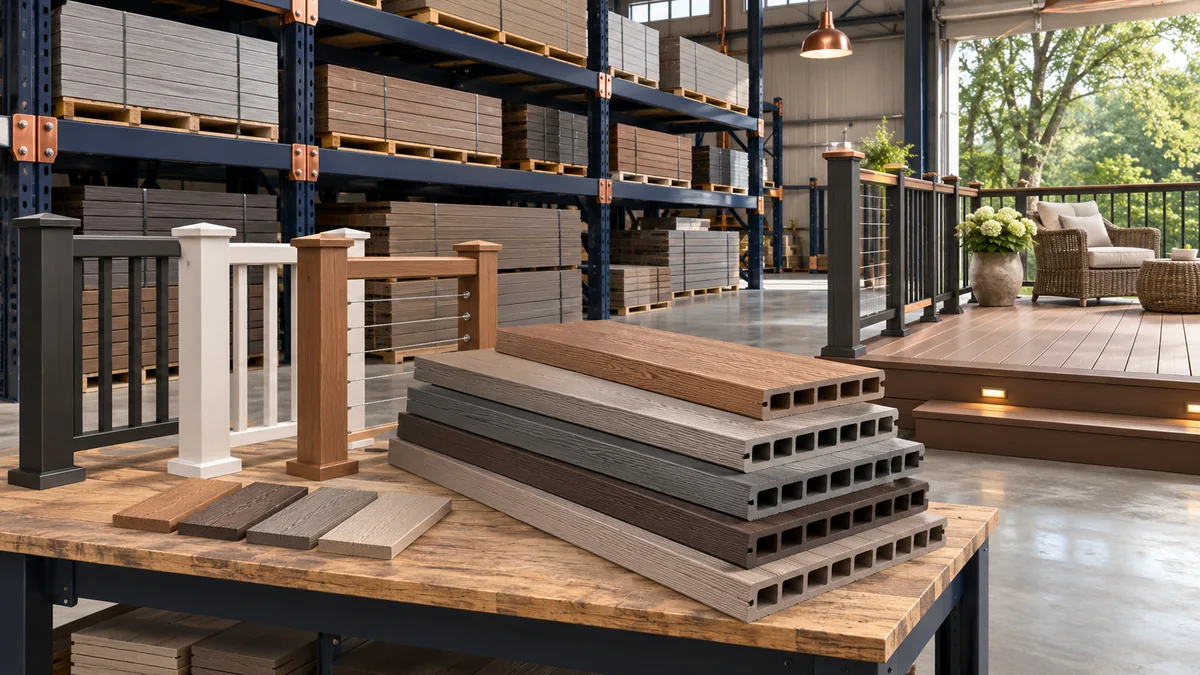
Trex's third-quarter shipments received a boost as new distributors filled their shelves. That initial stocking explains part of the sales increase, but not all of the company's outperformance against its original forecast.
Research by Ticker Byline shows that subtracting management's estimated $30 million of initial distributor orders from revenue of $359.5 million leaves about $329.5 million. That is still above the original $305 million to $320 million quarterly forecast.
The original forecast already anticipated some initial stocking. The calculation removes only the disclosed initial orders; shipments to distributors are distinct from purchases by homeowners.
Sales gain outpaces profit
Reported revenue rose from $285.3 million a year earlier, while net income increased only slightly to $52.5 million from $51.8 million. GAAP gross margin narrowed to 36.0% from 40.5%.
Management cited higher transportation and diesel costs, depreciation and startup inefficiencies at the Arkansas facility. It said a temporary mechanical issue had been resolved. Selling and administrative spending also rose, including investment in staff and brand-building.
The company said total channel inventory was comparable with the prior year as new distributors added stock and the former distributor reduced it.
A higher outlook, with cash still worth watching
Trex raised its annual sales forecast to $1.296 billion to $1.306 billion from $1.215 billion to $1.250 billion. It also raised adjusted EBITDA guidance to $355 million to $360 million from $335 million to $350 million. EBITDA measures earnings before interest, taxes, depreciation and amortization; Trex's adjusted version also removes specified costs.
Quarterly operating cash flow fell to $152.6 million from $196.9 million. Company-defined free cash flow declined more modestly to $134.6 million from $139.6 million, helped by lower spending on property and equipment. Its free cash flow also deducts purchased intangible assets.
Trex repaid $83 million of revolving borrowings during the quarter, leaving $170 million outstanding. That remained above the previous year-end balance. The next test is how distributor reordering and plant efficiency develop after the initial stock build. The Trex company profile tracks those changes alongside cash flow and borrowing.