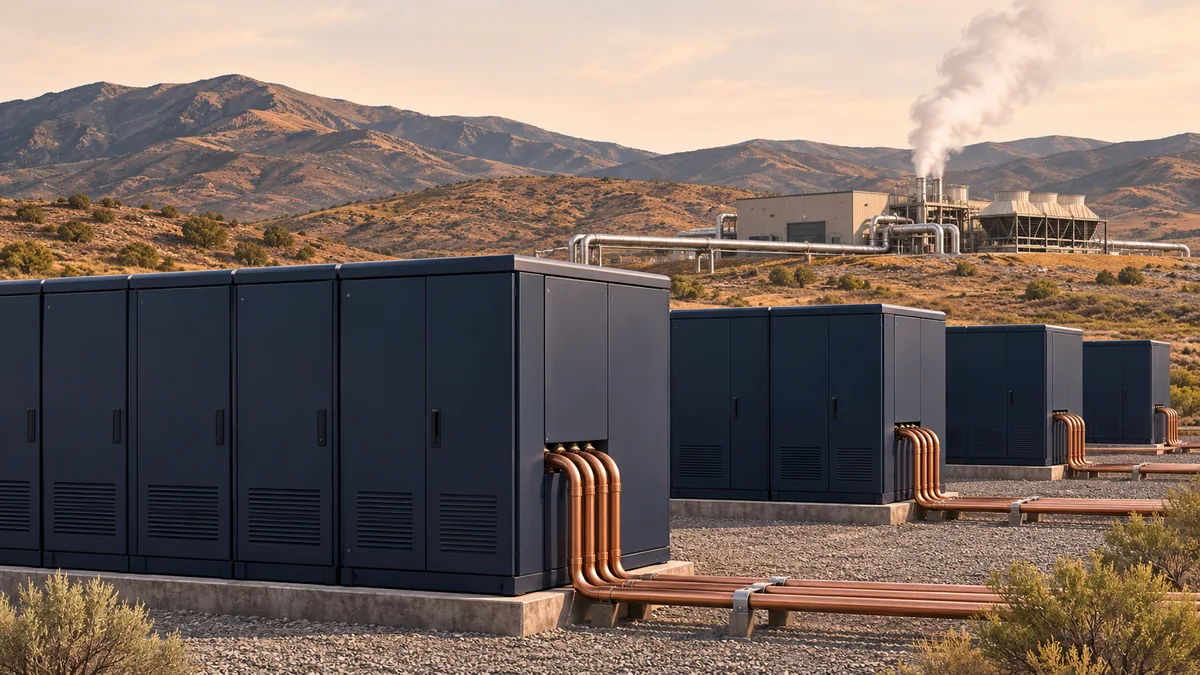
Ormat's storage sales surged. Why did its forecast barely move?
Battery storage lifted quarterly profit, but weaker electricity generation limited the annual upgrade. A comparison with August shows where the gains were offset.
Beyond the headline.
Inside the numbers.
Ticker Byline
Ormat operates geothermal power plants and battery storage, with electricity margins, project investment and financing shaping its growth.
Ormat Technologies Inc. develops, owns and operates geothermal and other renewable power plants, sells power-generation equipment and operates battery energy-storage facilities. Its shares trade on the New York Stock Exchange under ORA. Its fiscal year ends December 31.
| Measure | 2025 | 2026 |
|---|---|---|
| Revenue | $249.7 | $275.1 |
| Gross profit | $64.0 | $77.4 |
| Operating income | $40.4 | $45.3 |
| Consolidated net income | $24.7 | $29.8 |
| Net income attributable to shareholders | $24.1 | $31.9 |
| Diluted earnings per share | $0.39 | $0.51 |
| Adjusted EBITDA | $138.4 | $153.8 |
Revenue grew 10.2% and adjusted EBITDA grew 11.1%. The adjusted measure removes interest, taxes, depreciation, amortization and accretion, along with specified items including stock compensation, acquisition costs, impairments and unsuccessful exploration or storage write-offs.
Storage revenue rose to $49.9 million from $20.4 million and gross profit to $31 million from $8 million. Existing PJM facilities added $19.6 million of revenue, supported by pricing and availability; new facilities contributed $9.3 million. Market-based storage revenue was approximately $31 million versus $10.3 million, and fixed-contract revenue $18.9 million versus $10.1 million.
Electricity revenue fell to $163.7 million from $167.1 million and gross margin to 22.2% from 25.4%. A hurricane-related Puna well outage reduced revenue by $5.1 million, partly offset by Dominica and Olkaria. Product revenue was $61.5 million versus $62.2 million. Its gross margin fell to 16.5% from 21.7%, but recovered from Q2's 9.7%.
August's forecast was revenue of $1.15 billion to $1.20 billion and adjusted EBITDA of $630 million to $650 million. The latest ranges are $1.17 billion to $1.20 billion and $640 million to $650 million. Their midpoints rose by $10 million and $5 million.
Storage revenue is now expected at $160 million to $170 million, versus $140 million to $155 million. Electricity revenue moved down to $700 million to $710 million from $710 million to $725 million, while product revenue rose to $310 million to $320 million from $300 million to $320 million. Approximately $13 million of forecast adjusted EBITDA is attributable to minority interests, compared with $17 million in August.
Management's 2030 annual run-rate targets remain revenue of $1.5 billion to $1.6 billion and adjusted EBITDA of $1 billion to $1.1 billion. These match September's investor-day targets and exclude enhanced geothermal systems.
Operating cash flow was $228.9 million in the first nine months, versus $230.1 million a year earlier. Cash capital expenditures were $424.5 million versus $474.7 million, leaving a $195.5 million gap between operating cash and capital spending before other investing and financing flows.
Ormat received $976.1 million net from convertible-note issuance, paid $310.9 million to prepay older convertible notes, repaid $231.4 million of long-term debt and reduced revolving borrowings by a net $80 million. It also received $93.1 million from a power-plant sale and $51.9 million through tax-monetization financing transactions. These are separate from operating cash flow.
At September 30, cash and cash equivalents were $348 million, with another $164.2 million restricted. Loans, convertible notes and commercial paper totaled $3.086 billion at carrying value; financing liabilities were a separate $206.6 million. Unused corporate credit capacity was $387.9 million.
The remaining 2026 investment plan included $286.7 million of capital expenditure and $65.4 million of long-term debt repayment. Beyond the $190.6 million face amount of older notes due in 2027, holders of $175 million of Series B notes can require a cash repurchase in March 2027 even though their legal maturity is 2031. Project financing and tax-equity transactions remain part of the funding plan.
The Hoku solar-and-storage purchase closed January 29, 2026, for $79.3 million gross cash consideration. The acquired Hawaii facility contributed $2.9 million of Q3 storage revenue. Acquisition cash spending, net of acquired cash, was $78.3 million in the nine-month cash statement.
Ormat's 10-megawatt Dominica plant entered commercial operation in July. The 100-megawatt, 400-megawatt-hour Denali storage project is expected by the end of 2028 under a 20-year tolling agreement. Both milestones had already been disclosed in August.
On October 26, Ormat agreed to buy Northleaf's remaining Puna ownership interests for up to $59.5 million. The price comprises $38.4 million at closing plus 5% annual interest from the agreement date, and $21.1 million conditional on a repowering milestone. The conditional obligation expires if that milestone is not met by September 30, 2030. Closing is expected by January 7, 2027. Puna is already consolidated in Ormat's accounts.
Estimated enhanced-geothermal potential increased to 5 to 6 gigawatts across approximately 170,000 acres, from 3 to 4 gigawatts and 70,000 acres at September's investor day. The land position includes existing rights, awarded leases and nonbinding letters of intent. Potential projects depend on resource confirmation, land and water rights, permits, interconnection and economics. Pilot drilling with SLB and Sage is expected in late 2026 or early 2027; Dixie Valley power contracts remain under negotiation.
Battery storage lifted quarterly profit, but weaker electricity generation limited the annual upgrade. A comparison with August shows where the gains were offset.