Ormat's storage sales surged. Why did its forecast barely move?
Battery storage lifted quarterly profit, but weaker electricity generation limited the annual upgrade. A comparison with August shows where the gains were offset.
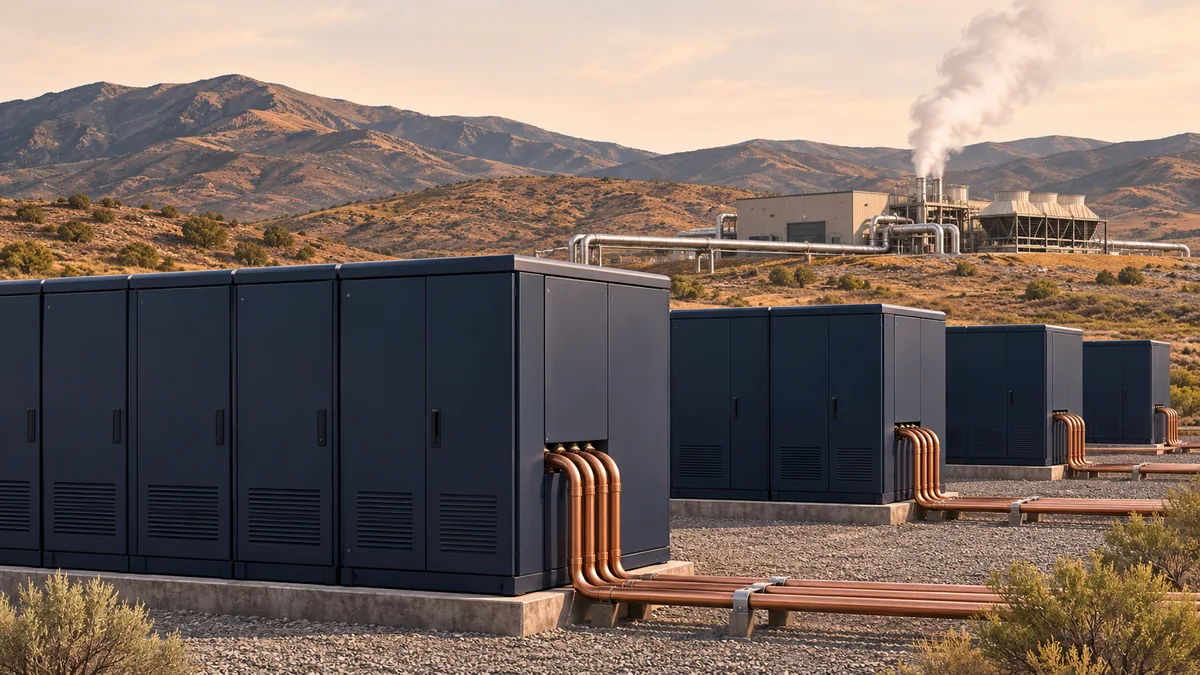
Ormat's energy-storage business more than doubled its third-quarter sales and nearly quadrupled its gross profit. The battery portfolio supplied the momentum behind a higher annual forecast, while the much larger electricity business moved in the opposite direction.
That split explains why a striking quarter for storage produced only a modest increase in the group's 2026 targets. It also gives investors a more immediate question than Ormat's expanding next-generation geothermal ambitions: how much can storage keep adding while power generation recovers?
A strong business carrying weaker ones
Storage revenue rose 145% to $49.9 million. Gross profit reached $31 million, up from $8 million a year earlier. That $23 million improvement exceeded the entire group's $13.3 million gross-profit increase, because electricity generation and equipment projects both earned less gross profit.
Existing battery assets in PJM, the power market covering parts of the eastern United States, generated $19.6 million more revenue. Strong market prices and high availability helped. Newly added facilities contributed another $9.3 million, including the Hoku solar-and-storage acquisition completed in January.
The price exposure matters. Storage facilities earned about $31 million from market-based sales, compared with $10.3 million a year earlier. Fixed-contract revenue also increased, to $18.9 million from $10.1 million. The portfolio's growth therefore combines new assets with better earnings from assets already operating.
The forecast comparison reveals the offset
Ormat now expects 2026 revenue of $1.17 billion to $1.20 billion, versus August's $1.15 billion to $1.20 billion. Its adjusted EBITDA forecast is $640 million to $650 million, up from $630 million to $650 million. The midpoint increases are $10 million and $5 million, respectively.
Research by Ticker Byline shows that the new storage revenue forecast adds $17.5 million at the midpoint, yet the group's forecast rises by only $10 million. Comparing the original August outlook with the latest targets reveals the main offset: expected electricity revenue falls by $12.5 million at the midpoint. Equipment-project revenue adds $5 million.
Electricity revenue fell 2.1% in the quarter to $163.7 million. A hurricane-related well outage at Puna in Hawaii reduced generation, partly offset by the new Dominica plant and better performance at Olkaria in Kenya. Electricity gross margin fell to 22.2% from 25.4%.
The equipment business also had a lower margin than a year earlier, although its 16.5% gross margin improved from 9.7% in the second quarter. That sequential recovery was part of the improvement management had expected in August.
Bigger geothermal potential, the same long-term targets
Ormat has expanded its estimated enhanced-geothermal development potential to 5 to 6 gigawatts, compared with 3 to 4 gigawatts presented at September's investor day. Enhanced geothermal systems aim to draw usable heat from underground rock beyond conventional geothermal resources.
The acreage includes existing rights, awarded leases and nonbinding letters of intent. Resources, water, permits, grid connections and project economics still determine what can be built. Pilot drilling with SLB and Sage is expected in late 2026 or early 2027, while power contracts for the proposed Dixie Valley commercial project remain under negotiation.
The larger opportunity has not changed Ormat's 2030 financial targets. Those still exclude enhanced geothermal systems, keeping the early projects separate from the operating plan behind the current forecasts.
Growth needs funding as well as profit
Group revenue rose 10.2% to $275.1 million and net income attributable to shareholders increased 32.2% to $31.9 million. Adjusted EBITDA, which removes interest, taxes, depreciation and specified items such as stock compensation and exploration write-offs, rose 11.1% to $153.8 million.
Cash tells a different part of the investment story. First-nine-month operating cash flow was $228.9 million, almost unchanged, while capital expenditure used $424.5 million. Ormat raised $976.1 million net from convertible notes during the period, with substantial cash also used for refinancing and debt repayments.
The company has also agreed to buy Northleaf's remaining Puna interests for up to $59.5 million, with part of the price tied to a repowering milestone. Closing is expected by January 7, 2027. Our Ormat company profile tracks that pending transaction, completed acquisitions, debt and the changing forecasts.
Storage is making a much larger contribution today. The next test is whether that performance can hold as Ormat spends on expansion and works to restore electricity margins.