Loar's higher outlook still points below its record quarter
The aircraft-parts maker raised its 2026 targets. A comparison with results already earned shows what the forecast leaves for the final three months.
Beyond the headline.
Inside the numbers.
Ticker Byline
Loar makes specialized components for aircraft and aerospace and defense systems. Its expansion combines organic growth with acquisitions.
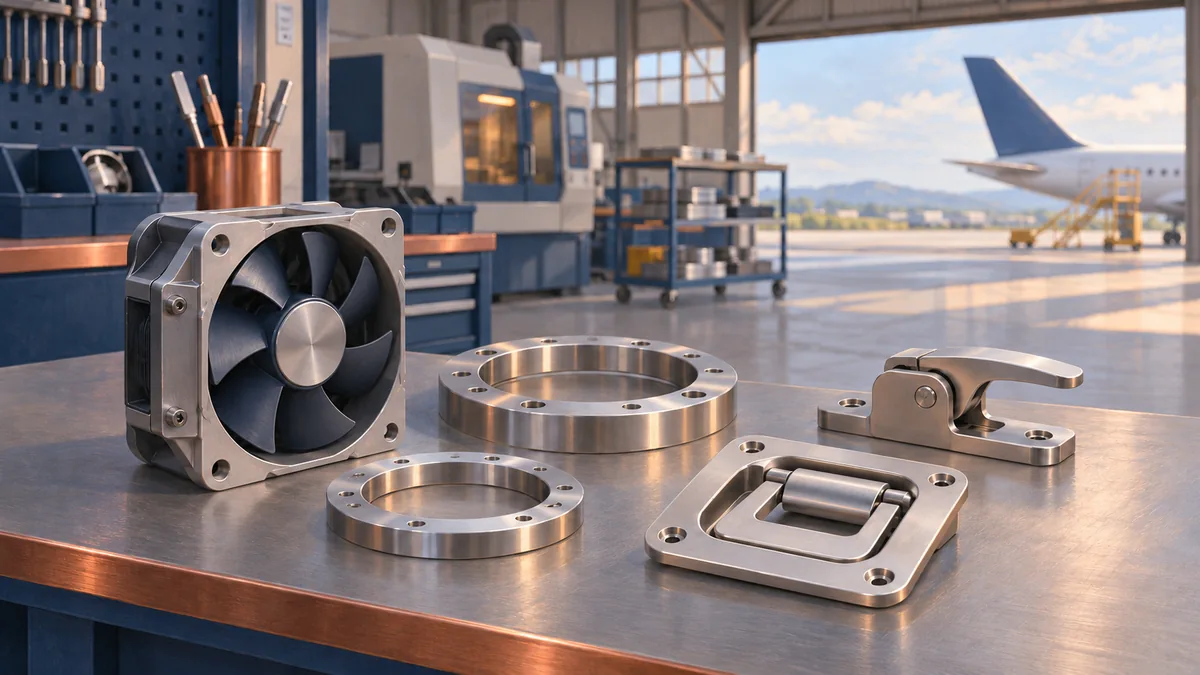
Loar Holdings Inc. designs and manufactures specialized components for aircraft and aerospace and defense systems. Its products include safety equipment, sensors, fans, brakes, lighting and devices that secure aircraft interiors. Its shares trade on the New York Stock Exchange as LOAR.
It supplies aircraft manufacturers and the aftermarket, which serves aircraft already in use. Commercial aviation, business jets and general aviation, and defense are its main end markets. Acquisitions are a central part of its expansion strategy. Its financial results are reported as one segment. Its fiscal year follows the calendar year.
| Measure | Q3 2025 | Q2 2026 | Q3 2026 |
|---|---|---|---|
| Revenue | 126.8 | 171.6 | 176.2 |
| Operating profit | 29.0 | 41.9 | 46.2 |
| Net income | 27.6 | 16.7 | 19.6 |
| Diluted EPS | $0.29 | $0.18 | $0.20 |
| Net interest expense | 6.0 | 20.0 | 20.0 |
| Adjusted EBITDA | 49.1 | 69.4 | 71.9 |
Adjusted EBITDA adds back net interest expense, taxes, depreciation and amortization, plus specified inventory, transaction, stock-compensation, acquisition-integration and other expense adjustments.
Organic sales growth accelerated to 15.8% in the third quarter from 12.3% in the second quarter. This measure excludes sales from newly acquired businesses until they enter the comparable base. Total third-quarter revenue rose 39%, including acquisitions.
Third-quarter net income fell 29% from a year earlier despite stronger operating profit. Net interest expense rose to $20.0 million from $6.0 million. The earlier quarter also included a $4.6 million tax benefit, helped by a one-time tax-law change, while the latest quarter carried $6.6 million of tax expense.
Interest expense was already about $20 million in the June quarter, when net income was nearly flat year over year. The subsequent earnings decline combines the continuing cost of acquisition debt with a tougher tax comparison.
Operating cash flow was $106.1 million in the first nine months of 2026, up from $81.9 million a year earlier. Capital spending was $12.5 million, versus $7.5 million. Cash spent on acquisitions was $249.8 million.
At September 30, cash was $159.3 million, up from $122.4 million in June and $84.8 million at December 31, 2025. Debt principal was $962.7 million, compared with $727.9 million at the prior year-end. The September debt carrying amount was $948.6 million after unamortized financing costs, with $3.0 million of finance-lease liabilities separately. Loar also had $50 million available on its revolving credit line.
Loar acquired LMB Fans & Motors on December 23, 2025, for $474.8 million in cash and $0.9 million of deferred consideration. LMB supplies fans and motors for aerospace and defense applications. An additional $445 million term-loan facility helped fund the transaction.
Harper Engineering followed on January 21, 2026, for $249.8 million in cash. Its aircraft-interior products include latching and securing mechanisms. Loar drew $240 million of term loans to help finance the purchase. The deal also includes contingent payments of up to $55 million tied to financial targets for 2026 through 2031; their estimated fair value was about $17.3 million at September 30.
Beadlight, acquired in July 2025, also contributed to acquisition-related sales growth over the first nine months of 2026.
On November 5, Loar raised its 2026 sales forecast to $669 million to $679 million from $665 million to $675 million in August. It lifted its net-income target to $60 million to $64 million from $56 million to $60 million, and adjusted EBITDA to $270 million to $275 million from $265 million to $270 million.
The initial 2027 outlook calls for sales of $745 million to $755 million, net income of $91 million to $95 million and adjusted EBITDA of $312 million to $317 million. Management assumes about $83 million of interest expense and $30 million of capital spending, compared with about $80 million and $20 million for 2026.
Subtracting the first nine months from the new 2026 annual ranges implies fourth-quarter revenue of $165.2 million to $175.2 million, net income of $12.5 million to $16.5 million and adjusted EBITDA of $65.4 million to $70.4 million. Each range is below the corresponding third-quarter result.
Our analysis of what Loar's higher annual forecast leaves for Q4 explains the implied quarterly comparison alongside its continuing annual growth plans.
The aircraft-parts maker raised its 2026 targets. A comparison with results already earned shows what the forecast leaves for the final three months.