Black Hills has a Google deal. The next $606 million needs approval.
A new transmission application puts another part of the data-center expansion on the clock, as cash spending runs ahead of operating cash flow.
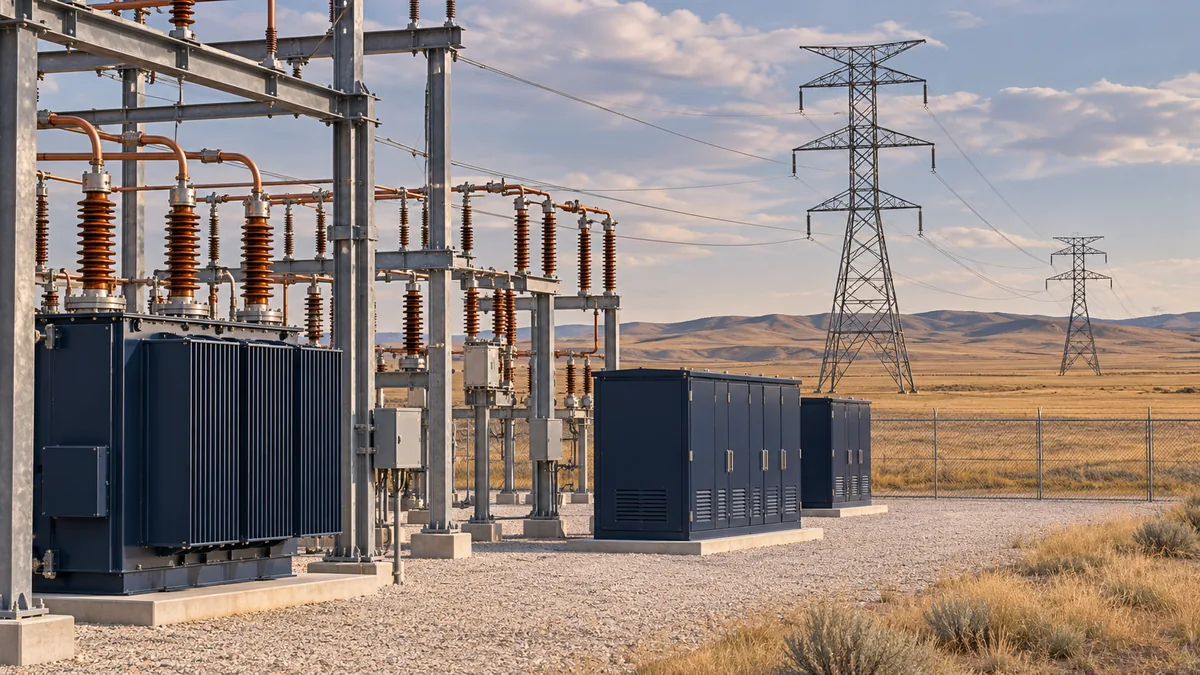
Black Hills has put a price and a timetable on another piece of its data-center expansion. Its Wyoming utility has applied to build a $606 million transmission project, with a regulatory decision expected in mid-2027.
The proposed Aeolus lines would help serve growing electricity demand around Cheyenne, including the region where Black Hills has signed a long-term deal with Google.
The next piece of the expansion
The November 2 application covers two new high-voltage lines spanning about 125 miles. Black Hills expects completion by mid-2029 if approved. Together with its earlier $80 million South Cheyenne proposal, the two transmission projects would cost $686 million.
Those proposals sit alongside $1.8 billion of planned company-owned generation for the Google project. The company now describes roughly $2.5 billion of additional generation and transmission investment to serve large data-center loads.
The Google agreement itself was announced on October 6. Black Hills already expected it to contribute earnings from 2027 and about $150 million of net income in 2030. The new transmission application gives investors another specific approval and construction schedule to follow.
The recovery timetable has changed
The utility also needs a tariff that would let it recover transmission costs directly from the large customers benefiting from the facilities.
Research by Ticker Byline shows that the latest expected decision comes after the approval date Black Hills originally requested. In August, it said it had sought approval by September 1, with the tariff effective January 1. It now expects a decision in the first quarter of 2027.
That timing matters because the expansion needs both permission to build and a route to recovering its costs. The company says its Google arrangements include cost pass-through and other protections intended to keep the project's costs from shifting to existing retail customers.
Today's business is earning more
The third quarter provides support for the investment story. Adjusted earnings rose to 57 cents a diluted share from 45 cents a year earlier. New rates and other regulatory cost recovery added 15 cents, and favorable weather added another 6 cents, offset by higher operating, financing and depreciation costs.
Reported profit available to common shareholders increased to $41.0 million from $24.9 million. The adjusted figure of $43.6 million removes after-tax merger costs. Both the electric and gas businesses increased operating profit.
Black Hills kept its annual adjusted earnings forecast at $4.25 to $4.45 a share. It also reported a newly approved South Dakota rate settlement expected to add $27.4 million in annual revenue. Those rates start in December, replacing interim rates already in place since August.
The cash arrives on a different schedule
Operating cash flow reached $542.6 million in the first nine months, up from $505.3 million. Cash investment in property and equipment rose faster, to $756.0 million from $550.2 million, as the company spent on its Lange II power plant and long-lead equipment for the Google project.
Google has provided $398.8 million of refundable construction advances. Black Hills records that money as a liability and expects to repay it by June 30, 2027. It plans to finance the generation investment using project cash flow and debt and equity instruments.
The company's proposed NorthWestern merger is also awaiting Montana approval. Our NorthWestern analysis examines the other utility's data-center demand and generation plans. The Black Hills company profile tracks the project milestones, rate decisions, cash and financing obligations.