NorthWestern's data-center forecast shrank. What remains?
Sabey's development agreement ended, and the expected first wave of demand is smaller. Generation costs and a pending merger add to the utility's investment questions.
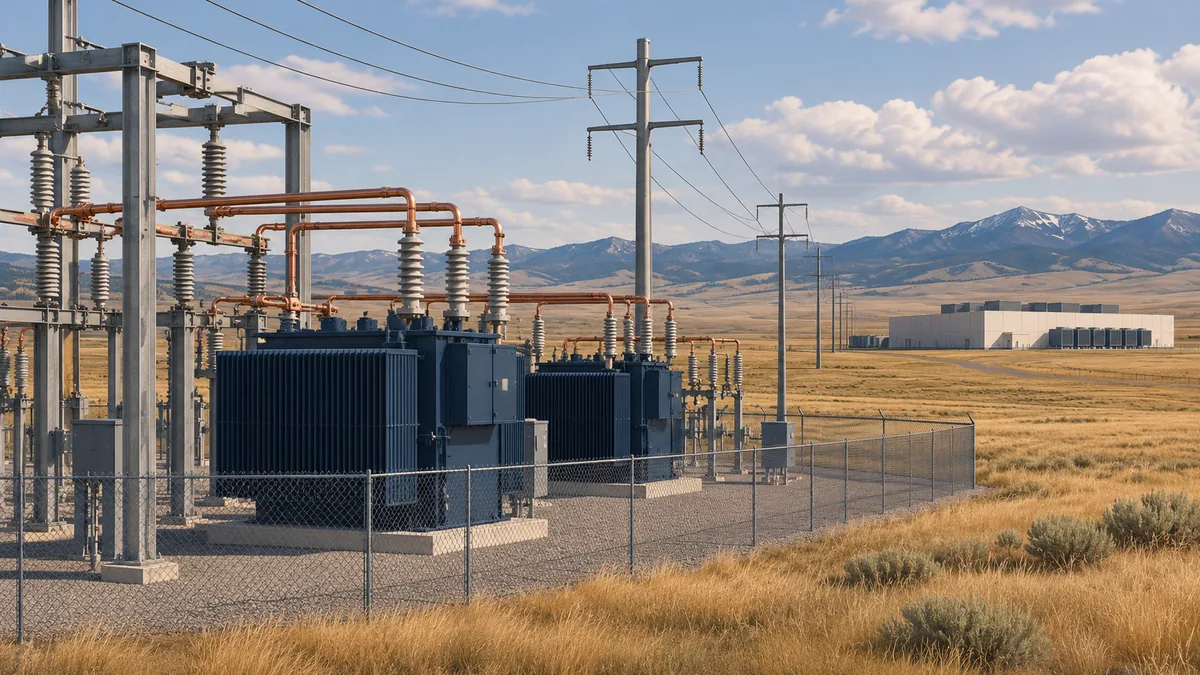
NorthWestern Energy has cut its expected first wave of data-center demand to 75 megawatts, down from 150 megawatts projected in July. Sabey Data Centers' development agreement has ended, leaving the utility working with Atlas Power and Quantica Infrastructure on future electricity-service agreements.
The change reduces one source of expected growth just as NorthWestern invests in generation and prepares for its proposed merger with Black Hills. Its annual earnings forecast remains intact, but the latest documents show how much of the growth story still depends on turning development plans into operating business.
A smaller pipeline, with substantial plans remaining
The first demand is still expected in late 2027. By 2030, NorthWestern now describes potential demand of up to approximately 1,250 megawatts or more, compared with approximately 1,500 megawatts or more in July.
Research by Ticker Byline shows that the projected first wave has halved since July, while the indicative 2030 figure is 250 megawatts lower. The September investor presentation still listed Sabey among the projects under development.
These agreements cover work to evaluate the power-generation and transmission infrastructure needed for proposed sites. NorthWestern is still negotiating the electricity-service contracts with Atlas and Quantica.
The utility has also proposed a Montana tariff framework for large new electricity users. That process is intended to set contract requirements and protect existing customers from bearing costs created by new large loads. Regulatory approval remains part of the route from a development agreement to service.
A larger power-plant estimate alongside the growth plans
Separately, the planned 131-megawatt Hub City Energy Park in Aberdeen, South Dakota, now carries an estimated cost of $470 million, compared with $300 million in July. The natural-gas project is intended to meet regional capacity needs by 2030.
NorthWestern continues to show a roughly $3.2 billion capital-investment plan for 2026 through 2030. Its latest presentation allocates $332 million to South Dakota generation within that schedule, without reconciling that amount to the higher full-project estimate.
Funding matters as much as the headline project list. The company expects to use operating cash, debt and future rate increases, with equity issuance for South Dakota generation beginning in 2027. That equity funding expectation was already in July's outlook.
Colstrip is already affecting earnings
The company completed its purchases of additional Colstrip coal-plant interests from Avista and Puget on January 1 for no cash purchase price. Those interests brought additional generating capacity and operating costs.
They reduced third-quarter net income by $6.1 million. NorthWestern removes $3.2 million of that impact in its adjusted results, leaving a $2.9 million drag even after the adjustment.
Reported net income fell to $30.7 million from $38.2 million, despite revenue rising to $423.8 million from $387 million. Diluted earnings per share were $0.50 versus $0.62; adjusted earnings were $0.58 versus $0.79. Depreciation and interest costs also increased.
The full-year adjusted earnings target stays at $3.68 to $3.83 per share. It continues to assume regulatory approval of a power-cost recovery waiver and sufficient power prices to recover costs associated with the additional Colstrip interests. Those assumptions were already present in July.
The merger is another near-term milestone
NorthWestern expects the Montana regulator to consider the Black Hills merger before November 12. It still anticipates closing by year-end, subject to satisfactory approval and the other closing conditions. Its current forecasts cover NorthWestern as a standalone company.
Operating cash flow increased to $364.1 million in the first nine months, while cash spending on property and equipment reached $464 million. The cash-flow improvement was helped by the timing of energy-supply cost collections. Our NorthWestern company profile tracks those figures, debt, completed Colstrip purchases and the pending merger.
Atlas and Quantica leave meaningful growth potential on the table. The next evidence investors need is progress toward signed service contracts, alongside a clearer funding picture for the generation being built.