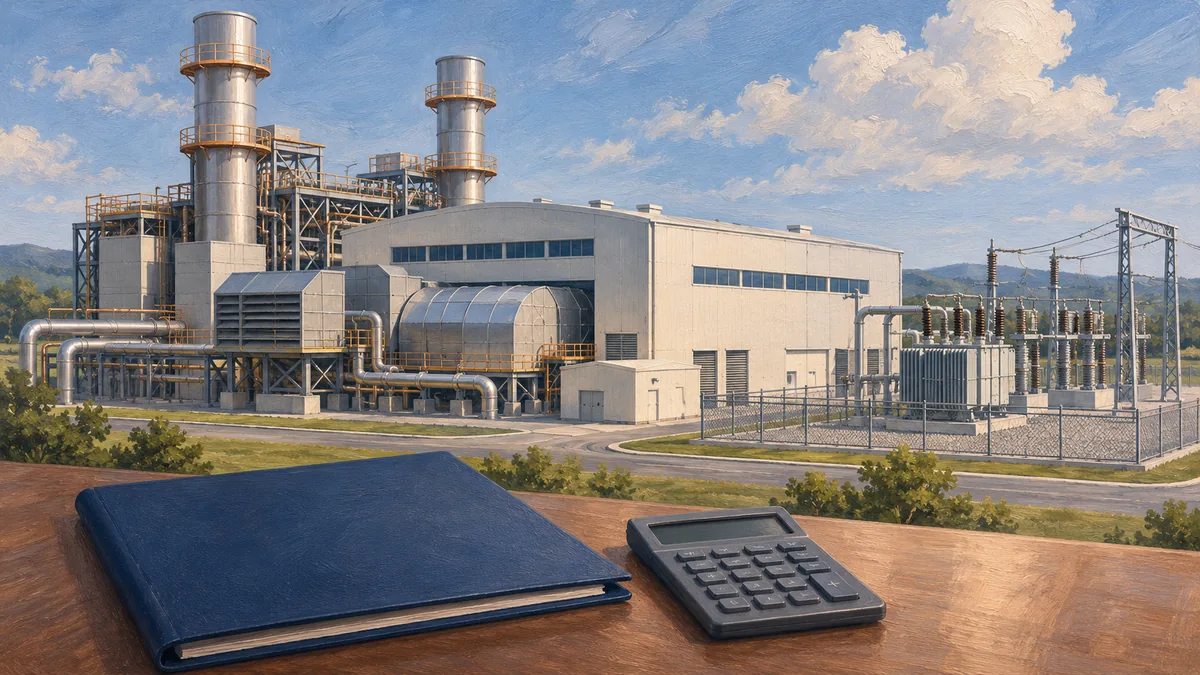
Vistra bought ten power plants. The cash bill didn't stop there.
A $1.7 billion debt payoff followed the Cogentrix closing. New figures show how the deal, a preferred-stock redemption and fresh borrowing reshaped Vistra's available funding.
Beyond the headline.
Inside the numbers.
Ticker Byline
Vistra generates electricity from natural gas, nuclear, coal, solar and storage assets and sells electricity to retail customers.
Vistra generates electricity and sells it to retail customers. Its fleet uses natural gas, nuclear, coal, solar power and battery storage, with operations across major competitive U.S. electricity markets. The Irving, Texas company trades as VST on the New York Stock Exchange and NYSE Texas.
The business earns money from electricity sales, payments for keeping generation capacity available and retail supply contracts. Hedging agreements lock in prices for much of its expected generation, so spot power prices do not flow straight through to earnings.
Vistra completed the Cogentrix Energy acquisition on October 30, 2026, buying ten gas-fired plants with about 5.5 gigawatts of capacity from funds managed by Quantum Capital Group. The purchase brought its overall fleet to nearly 50 gigawatts.
Closing consideration included about $2.2 billion of cash and 5 million newly issued shares, valued by agreement at $185 each. Vistra assumed about $1.7 billion of debt and confirmed in its November 6 results that it had repaid that debt.
The company plans to sell the acquired 271-megawatt Rumford plant in Maine following competition concerns raised by the Justice Department. The latest presentation identifies that sale as expected.
Earlier completed deals included Energy Harbor in March 2024, adding nuclear generation, and the Lotus gas-plant portfolio in October 2025. Lotus contributed to Q3 2026 results; Cogentrix closed after that reporting period.
| Measure | 2025 | 2026 |
|---|---|---|
| Revenue | 4,971 | 6,347 |
| Net income | 652 | 1,140 |
| Ongoing adjusted EBITDA | 1,581 | 2,378 |
Higher realized power prices, capacity revenue, retail performance and Lotus helped Q3 earnings. Reported net income included a $559 million unrealized hedge gain. Adjusted EBITDA removes unrealized hedge gains and losses, interest, taxes, depreciation, amortization and specified other items.
For the first nine months of 2026, operating cash flow was $4.33 billion, versus $2.64 billion a year earlier. Capital spending, including nuclear fuel purchases and long-term service agreement prepayments, was $2.32 billion, versus $1.92 billion.
September 30 cash was $2.74 billion. Including unused corporate and commodity-linked borrowing capacity, total available liquidity was $8.92 billion. A separate $1.375 billion of receivables-financing capacity was excluded from that total.
In October and November, Vistra used the full receivables facilities, paid the Cogentrix cash consideration, repaid the acquired debt and separately redeemed $1 billion of Series A preferred stock. Its September liquidity position adjusted for those transactions was about $5.4 billion.
The presentation's pro forma corporate debt total was $22.82 billion, excluding project-level financing. The company continues to target an investment-grade balance sheet while funding growth and shareholder returns.
In August, Vistra expected 2026 ongoing adjusted EBITDA of $6.8 billion to $7.6 billion and adjusted free cash flow before growth of $3.925 billion to $4.725 billion. November guidance narrows those ranges to $7.1 billion to $7.5 billion and $4.3 billion to $4.7 billion.
For 2027, the first formal guidance is $7.7 billion to $8.5 billion of ongoing adjusted EBITDA and $4.3 billion to $5.1 billion of adjusted free cash flow before growth. It includes Cogentrix and the first phase of the Meta operating power-supply agreement. The earlier 2027 earnings opportunity discussed in August excluded those developments and was not formal guidance.
The adjusted cash-flow measure removes working-capital and margin-deposit movements and deducts maintenance spending rather than all growth investment. Vistra plans about $3.15 billion of total capital spending in 2027, including growth projects.
A newly approved $1.5 billion buyback authorization brings remaining capacity to about $2.5 billion, which management expects to complete by the end of 2028. The next checks are Cogentrix's contribution, the planned Rumford sale, cash generation after investment and the pace of buybacks.
A $1.7 billion debt payoff followed the Cogentrix closing. New figures show how the deal, a preferred-stock redemption and fresh borrowing reshaped Vistra's available funding.