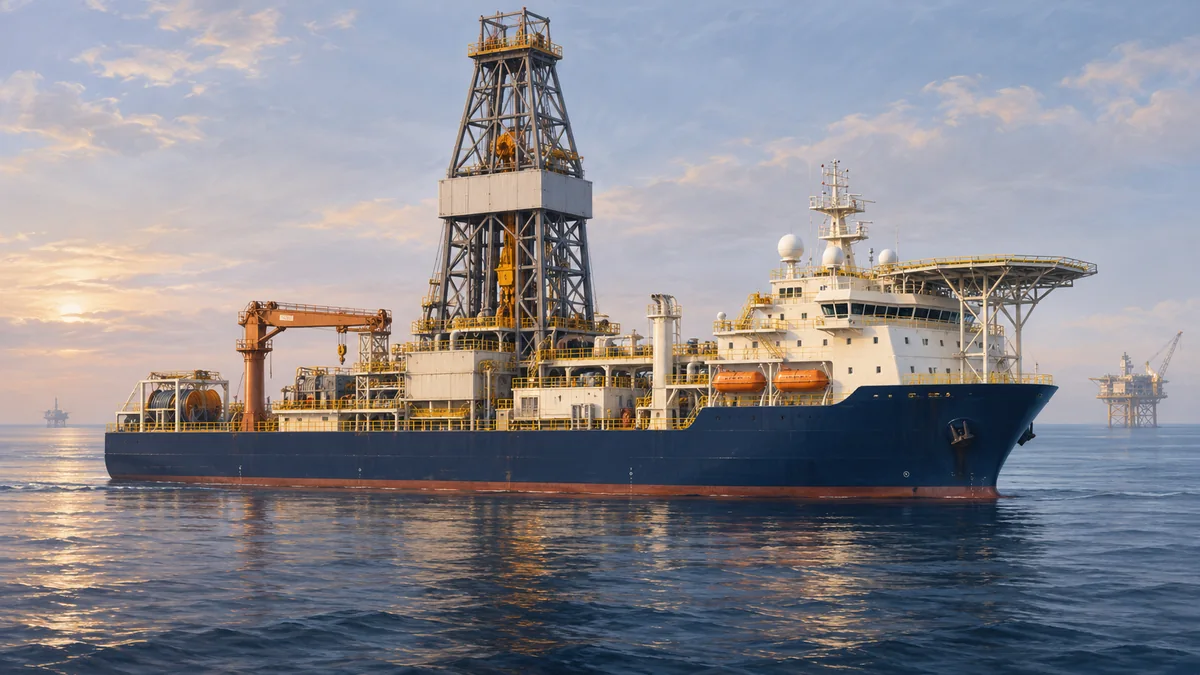
Valaris Limited (NYSE: VAL) provides offshore drilling services. Its fleet includes deepwater drillships and jackup rigs for shallower waters. It also leases rigs to ARO Drilling, a joint venture in which it holds a 50% stake.
Quarterly recovery in context
Amounts are USD millions. Q3 covers July through September; Q2 covers April through June.
Adjusted EBITDA excludes interest, taxes, depreciation, asset-sale gains, merger and integration costs, other specified accounting items and Valaris's share of ARO's earnings or losses. ARO's full operating results are reported separately from the consolidated business.
Third-quarter net income included a $23 million discrete tax charge, mostly noncash and related to rig sales. The second quarter had a $6 million tax benefit. Asset-sale gains fell to $27.5 million from $37.7 million. These changes help explain why stronger adjusted operating results did not produce higher reported profit.
Earlier promises and actual rig starts
In August, management expected two additional drillships to begin new contracts before the end of 2026. DS-15 started in September, and DS-18 started after September 30. The latest release says all ten active drillships are now under contract.
DS-12 began its contract in April and DS-10 in June, allowing a full third quarter of work. The jackup VALARIS 116 returned to its ARO charter in September, as previously expected; VALARIS 250 had returned in July.
Management estimates the Middle East conflicts reduced adjusted EBITDA by about $24 million in Q3, compared with $30 million in Q2. It cited lower war-risk insurance costs as one reason the impact moderated.
Cash, investment and debt
Our calculation of operating cash flow less capital spending leaves a $54.4 million shortfall in Q3, compared with $92.4 million in Q2. Asset-sale proceeds of $42.3 million were a separate source of cash.
For the first nine months of 2026, operating cash flow was $155.3 million and capital spending was $328.0 million, compared with $474.0 million and $237.2 million a year earlier.
Cash and equivalents were $525.1 million at September 30, versus $541.2 million at June 30. Restricted cash of $16.5 million was separate. Long-term debt had a carrying value of $1.089 billion.
Contract coverage
Total backlog was $4.750 billion on November 2, up from $4.585 billion on August 5. Approximately $600 million of new awards and extensions included about $290 million for a three-year bp platform-services extension beginning in January 2027. The net change in total backlog was about $165 million.
Drillship backlog was $2.904 billion, compared with $3.016 billion in August. Backlog represents contracted future revenue and excludes unexercised options and specified lump-sum fees.
Pending Transocean combination
The combination announced in February 2026 remains pending. Valaris said on November 2 that required regulatory approvals had been received and closing was expected around December 1, 2026.
Future results can test the contribution from newly started contracts and whether operating cash flow can cover capital spending as more of the fleet works.