MDU wants to control a $3 billion pipeline. Who helps pay for it?
Customer commitments support Bakken East. The financing terms will help determine how much of its future growth MDU shareholders keep.
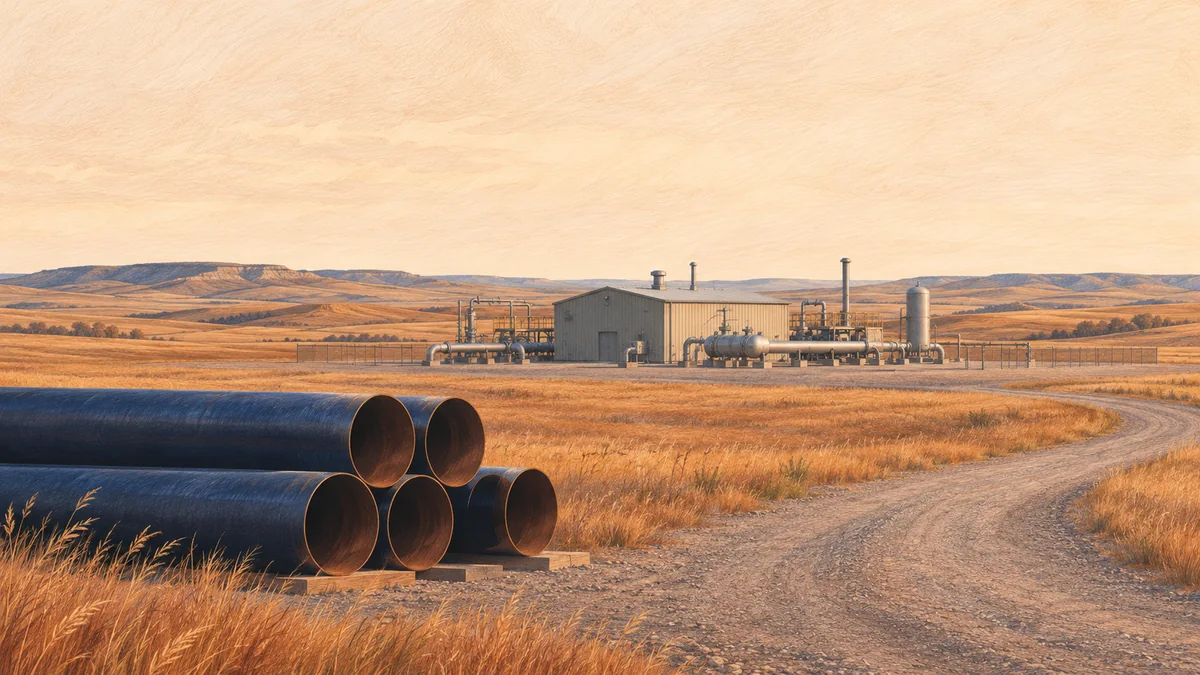
MDU Resources wants outside investors to help build the proposed pipeline while keeping majority ownership and operational control. Finding partners on those terms is the next important piece of the Bakken East project.
The estimated $2.8 billion to $3.1 billion pipeline would carry natural gas across North Dakota. The board approved moving ahead in September. MDU's latest quarterly report now spells out that definitive project financing and partners have yet to be secured, and that a partnership could involve sharing returns and decision-making power.
What would a partner get?
In its August update, MDU was evaluating financing and partnership options. November's release adds the expectation that its WBI Energy business will retain the majority stake and run the pipeline.
A partner could reduce the amount MDU needs to supply itself. In return, that investor would receive a share of the project's economics and potentially a say in its operation. The eventual agreement will determine how much of Bakken East's growth reaches MDU shareholders.
The company has not specified the split between project debt, its own equity and outside investors. Construction is expected to begin in 2028, with the first phase targeted for late 2029 and the second for late 2030, subject to regulatory approval.
Customer commitments support the plan
Customers have signed preliminary transportation agreements covering nearly 1.2 billion cubic feet of gas per day, against a design capacity of 1.4 billion. Those agreements still have conditions to satisfy.
North Dakota's support includes a capacity commitment of up to $50 million a year for 10 years. That is a commitment to use pipeline capacity, rather than an upfront contribution to construction funding.
The cost estimate has become narrower since August, when it was $2.7 billion to $3.2 billion. Both ranges have the same $2.95 billion midpoint. The revised estimate offers a tighter planning range without lowering that central figure.
The existing business still has work to fund
MDU also operates electric and gas utilities. Its electricity business earned about $26.5 million in the third quarter, up from $21.5 million a year earlier, helped by new rates, the Badger Wind investment and higher sales volumes.
Gas distribution recorded a larger seasonal loss, while pipeline earnings fell to about $13.1 million from $16.8 million. Higher costs, including advisory spending on Bakken East, weighed on the pipeline result.
For the first nine months, continuing operations generated $346.3 million of operating cash, down from $393.5 million, largely because of collection and cost-recovery timing. Cash capital spending was $332.1 million, alongside $13.1 million of net removal costs and $86.7 million of dividends paid. MDU raised $170 million of net equity proceeds during the period to help finance the broader business.
At September 30, the group had $588.5 million of available borrowing capacity. It reported compliance with debt covenants and investment-grade ratings at its debt-issuing entities.
Management kept its 2026 EPS forecast at $0.93 to $1.00 and its long-term annual growth objective at 6% to 8%. The next project announcement that matters for shareholders is the funding agreement: who contributes the money, who keeps control and how the resulting earnings are divided.
Our MDU Resources company profile follows earnings, cash flow, earlier expectations and the Bakken East timetable.