Freeport's $4.5 billion copper expansion joins a crowded budget
Bagdad could produce more copper at lower long-term unit costs. Its funding schedule overlaps other projects and Grasberg's recovery.
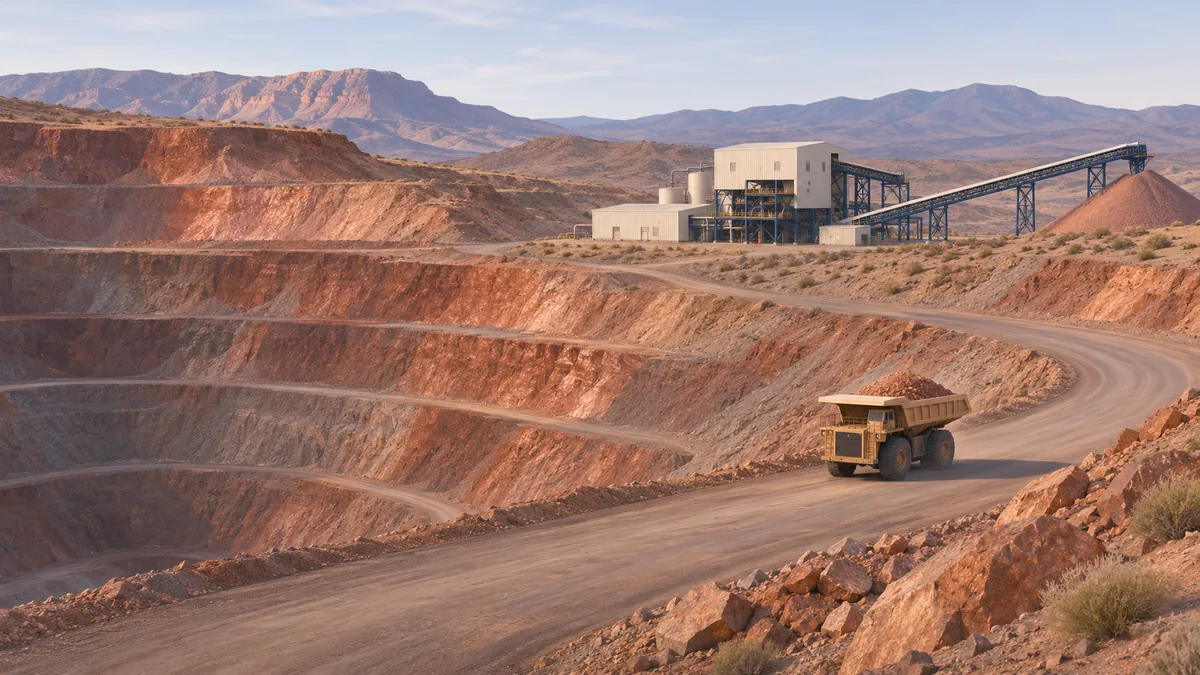
Freeport has approved its $4.5 billion Bagdad expansion, putting a spending schedule behind one of its major U.S. copper-growth options. About $900 million of the project bill is expected in 2027, with initial production targeted for mid-2030.
The investment could add approximately 225 million pounds of annual copper production and 12 million pounds of molybdenum, a metal used to strengthen steel and other alloys. Freeport also expects the larger, more automated Arizona operation to have lower long-term unit costs.
The immediate investor question is how the project fits alongside the recovery at Grasberg in Indonesia and a pipeline of other investments.
The budget already had room for some Bagdad work
The November 4 board decision advances a plan that was already well developed. Freeport's August quarterly report put the expansion estimate at about $4.5 billion. By October, the company was preparing for an investment decision before year-end.
Research by Ticker Byline shows that October's $5.2 billion capital-spending plan for 2027 already included early work at Bagdad. Freeport says it will incorporate the approved investment into an updated group outlook.
The new project schedule calls for about 20% of the cost in 2027, 30%–35% in 2028 and the rest in 2029–2030. The roughly $900 million first-year allocation comes from applying that 20% share to the $4.5 billion estimate.
The earlier project estimate also excluded $200 million of preparatory work already incurred through September. The approval moves Freeport into the main expansion phase of an existing operation.
What Freeport expects to get for the money
More processing capacity, new infrastructure and automation would lift Bagdad's long-term copper output above 400 million pounds a year. Management expects unit net cash costs to fall about 20%, helped by scale and revenue from molybdenum produced alongside the copper.
Freeport says the project's break-even economics work at roughly $4 per pound of copper together with $20 per pound of molybdenum. Those are the commodity-price assumptions supporting its investment case.
Building on an operating mine gives the project existing infrastructure and an experienced workforce. The larger production contribution is still several years away, making the construction schedule and spending discipline important to the eventual return.
Grasberg's recovery matters before Bagdad starts
Freeport expects Grasberg to approach full capacity by the end of 2027 as it recovers from the September 2025 mud-rush incident. Its Kucing Liar development also requires an estimated additional $4 billion through 2033.
Current cash generation provides support. Freeport generated $5.52 billion of operating cash flow in the first nine months and spent $3.24 billion on capital projects. That cash flow included $699 million of insurance proceeds.
At September 30, the company estimated about $3.3 billion of cash was available to the parent after minority shareholders' interests and withholding taxes. Future production growth and commodity prices will help determine how much cash the wider group can supply while Bagdad is under construction.
The next updated capital budget will show how Freeport folds the approved expansion into spending already planned. The Freeport company profile follows that budget, current earnings, debt, Grasberg's recovery and the other projects sharing the investment pipeline.