Solstice's merger is off. Its buyback now has a timetable.
Management wants to substantially complete the $500 million program by March. Strong cash generation supports the plan, though preparing the abandoned deal also cost money.
Solstice Advanced Materials wants to substantially complete its $500 million share-buyback program by the end of March 2027. It repurchased $100 million in the third quarter, as growing sales and cash generation helped shift the focus after its proposed merger with Element Solutions ended.
Research by Ticker Byline shows that the August 27 announcement already contained the buyback authorization and the merger's mutual termination. The new earnings release adds a timetable for using that authorization.
What is funding the buyback?
Solstice generated $693 million of operating cash flow in the first nine months, compared with $289 million a year earlier. After $325 million of capital spending, its free cash flow was $368 million.
Some of the cash improvement came from working capital. Higher accrued and other current liabilities contributed $201 million to operating cash flow. Cash and cash equivalents reached $714 million at September 30.
The abandoned merger also used cash. The cash-flow statement separately records $34 million of fees for the deal's bridge and backstop financing under financing activities. That payment sits outside the $368 million free-cash-flow figure. Neither merger party owed the other a termination fee.
Growth is reaching adjusted earnings
Quarterly sales rose to $1.046 billion from $969 million, above the $990 million to $1.030 billion range reaffirmed in August.
Adjusted EBITDA reached $265 million, versus $235 million on the prior-year standalone basis. This measure removes financing, tax, depreciation and specified other costs; the older comparison includes estimated costs of operating independently after the separation from Honeywell.
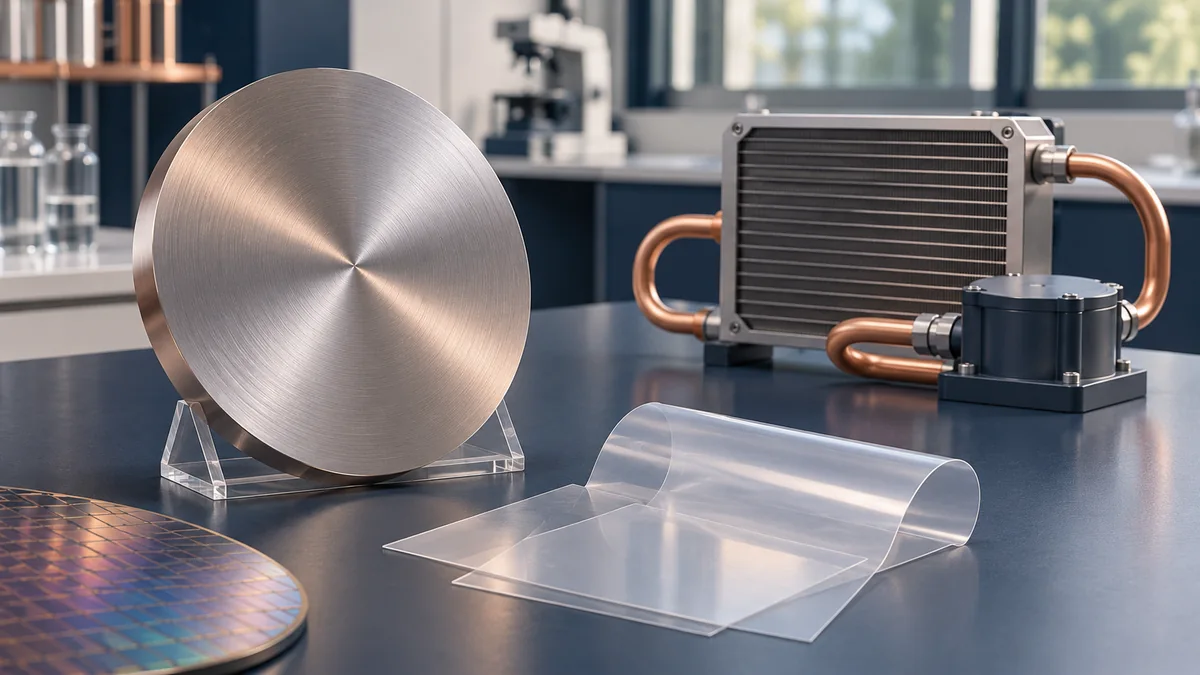
Electronic and Specialty Materials increased adjusted EBITDA to $68 million from $47 million. Electronic Materials, part of that segment, lifted sales to $135 million from $103 million. Solstice linked the growth to semiconductor materials and cooling products used in memory and AI applications.
Net income attributable to Solstice rebounded to $80 million from a $35 million loss. A much smaller tax charge helped: income tax expense fell to $24 million from $182 million, when the company incurred taxes associated with its separation.
Solstice raised the lower end of its annual adjusted earnings-per-share forecast to $2.90 from $2.75, retaining the $2.95 upper end. It kept its $420 million to $440 million capital-spending forecast.
The Solstice company profile follows that investment, its debt and the operating results behind the buyback timetable.