Permian Resources sold cheaper oil. How did adjusted cash flow rise?
Gas-rich wells returned to production as regional prices improved. A stronger adjusted cash result comes with a bigger spending plan and a different picture of actual cash.
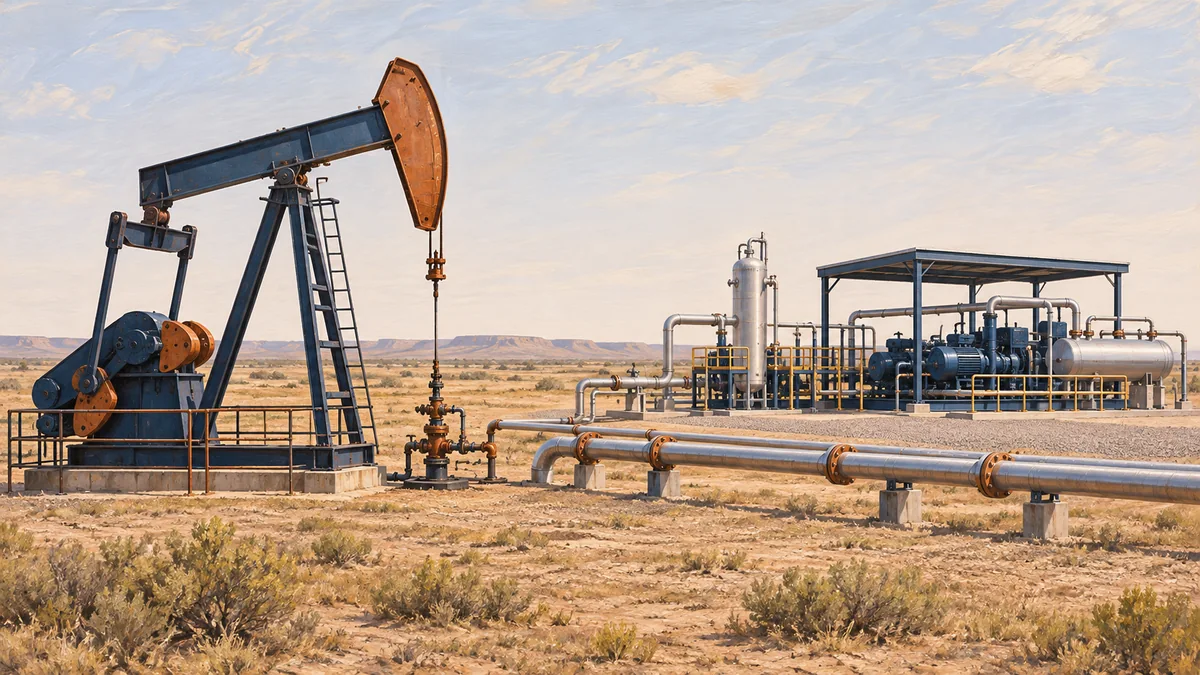
Permian Resources received less for each barrel of oil in the third quarter, yet its adjusted free cash flow rose 13% from the previous quarter. Gas-rich wells that had been held back by negative regional prices helped change the result.
Those wells returned to production as gas prices improved. More gas also reached markets along the Gulf Coast and around Dallas-Fort Worth, helping turn a quarterly gas-revenue loss into a positive contribution.
The recovery supports a higher production target and a larger investment program. It also comes with a useful distinction: the company's improved adjusted cash figure removes payment timing, while the actual cash left after capital spending fell.
Our Permian Resources company profile follows production, financial results, spending plans, debt and completed acquisitions.
Gas stopped being a drag
Permian Resources produces oil, natural gas and natural gas liquids in the Permian Basin, mainly in the Delaware Basin of West Texas and southeastern New Mexico. Wells can produce a mix of those products, so poor gas prices can affect the economics of producing the oil too.
Management had curtailed gas-rich wells during the second quarter, when regional prices were negative. Bringing them back helped daily gas production rise 42% and natural gas liquids production rise 37% in the September quarter. Oil output rose 5% to about 208,000 barrels a day.
Gas revenue, including purchased-gas transactions, improved to about $53 million from a loss of $87 million. Natural gas liquids revenue rose by another $81 million. That helped offset an oil sales price of $85.73 a barrel before hedges, down from $97.81 in the second quarter.
Adjusted free cash flow reached $845.6 million, compared with $750.8 million. Cash capital spending was nearly unchanged at $518.3 million.
Why actual cash moved the other way
Research by Ticker Byline shows that cash from operations minus cash capital spending fell to about $736 million from $984 million in the second quarter. We calculated the same measure from each quarter's reported operating cash flow and spending.
The difference comes from working capital: the timing of customer receipts, supplier payments and other operating balances. That timing boosted reported cash in the second quarter and absorbed cash in the third. Permian Resources removes those movements from its adjusted measure.
Reported operating cash flow consequently fell to $1.25 billion from $1.51 billion, while adjusted operating cash flow rose to $1.36 billion from $1.27 billion. The adjusted comparison shows stronger cash generation from the period's activity; the reported figures show what actually reached the cash balance.
Costs have another distinction. Lower expenses for gathering, processing and transporting gas partly reflect fees being deducted from gas and liquids revenue under changed contracts. The quarterly report says that presentation change explains the decline against the year-earlier quarter. The company also reported operating improvements in power and compression.
A larger plan, with more money committed
Permian Resources now expects average 2026 oil production of 201,000 to 204,000 barrels a day, up from August's 197,000 to 201,000. Its annual cash capital budget increased to $1.975 billion to $2.075 billion, from $1.9 billion to $2.0 billion.
Higher ownership interests in wells and more work on existing wells account for much of the additional spending. About $20 million relates to the newly completed Ridge Runner acquisition.
Ridge Runner closed October 30 for approximately $1.025 billion in initial cash consideration, plus up to $125 million tied to oil prices in 2027 and 2028. It adds adjacent New Mexico acreage and production. The company expects it to contribute about 4,000 barrels a day of oil in the fourth quarter; it contributed nothing to the third-quarter result.
The purchase was funded with cash and commercial paper, a form of short-term borrowing. September's $95 million cash balance and $393 million of commercial paper predate that funding. A $3 billion revolving credit facility backs the commercial-paper program.
For the fourth quarter, management expects oil output above 210,000 barrels a day with cash capital spending similar to the third quarter. Meeting that target would show whether the reopened wells, higher ownership interests and acquired production can sustain the larger program's cash returns.