Murphy Oil beats its output target. Why did free cash flow fall?
Earlier well deliveries lifted production and the annual outlook. A heavier investment program left less cash after spending, with another offshore commitment ahead.
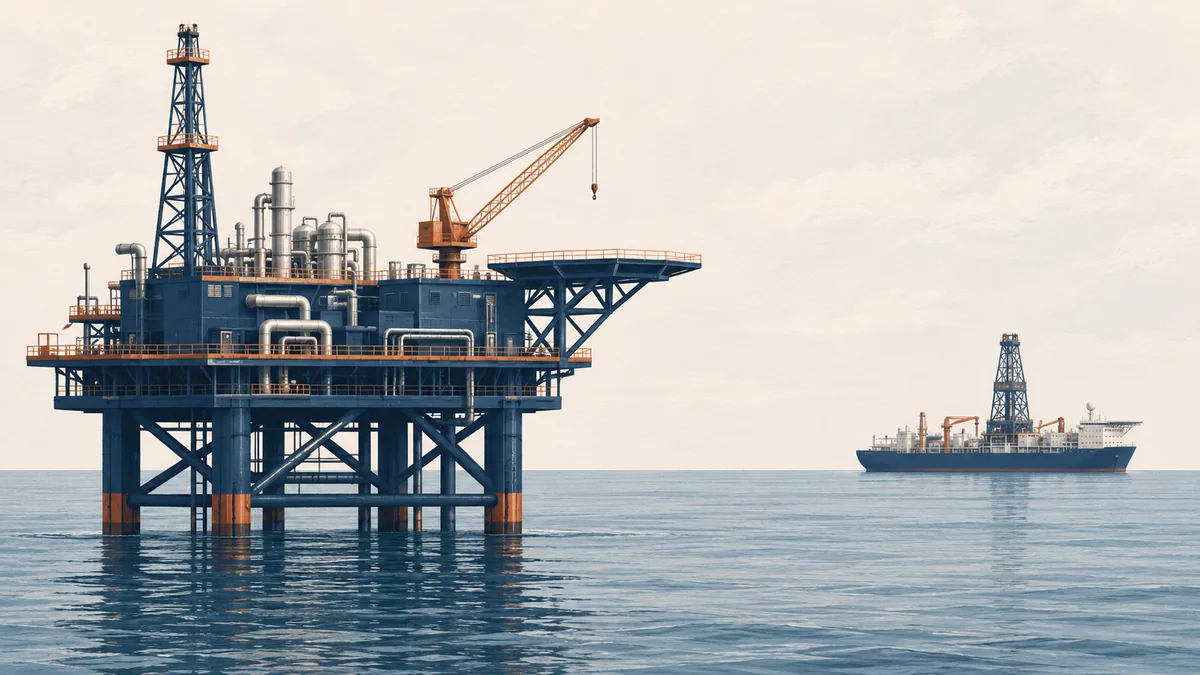
Murphy Oil delivered more oil and gas than it had forecast for the third quarter and raised its full-year production outlook. Yet the cash left after investment fell sharply as the company spent more to develop its next sources of production.
The independent producer kept its annual capital budget at $1.5 billion to $1.6 billion, the range set in August. The production upgrade therefore comes without another increase in that budget. The question for shareholders is how quickly the larger investment program turns into cash they can receive.
A production beat with an element of timing
Murphy's third-quarter output averaged 186,495 barrels of oil equivalent a day, a measure that combines oil, natural gas and natural gas liquids. Its original August forecast was 171,000 to 179,000.
Research by Ticker Byline shows that output exceeded the top of that original range by about 4.2%, while Murphy's planned annual total of 35 operated Eagle Ford wells stayed unchanged.
Six wells originally scheduled for the fourth quarter came online in the third, lifting that quarter's operated Eagle Ford deliveries to 14. Murphy also reported stronger-than-expected new wells and lower royalties in Canada's Tupper Montney gas operation. The result was a beat against its own plan, even though total production remained below the year-earlier 200,383 barrels of oil equivalent a day.
Full-year output is now expected to average 176,000 to 178,000 a day, up from 167,000 to 175,000. The fourth-quarter forecast is lower than the latest quarter, partly reflecting the earlier well deliveries and higher anticipated gas royalties. Hurricane Isaias also reduced the fourth-quarter forecast by about 3,700 a day.
More operating cash, much more investment
The underlying business generated more cash. Third-quarter operating cash flow rose to $540.5 million from $339.4 million a year earlier, helped by higher realized commodity prices and lower operating costs.
But cash spending on property additions and unsuccessful exploration wells reached $466.9 million, versus $149.0 million. That increase absorbed more than the improvement in operating cash.
Murphy's free-cash-flow measure also removes the effect of working-capital timing, such as when customers pay and suppliers are paid. On that basis, free cash flow fell to $48.2 million from $218.8 million. After dividends and the other cash deductions in its adjusted measure, Murphy reported an $8.4 million shortfall.
That weaker quarter came within an improving year-to-date picture: nine-month free cash flow was $199.6 million, slightly above $191.7 million a year earlier. And the quarter's $422.2 million of capital spending on an accrual basis, which records costs as incurred rather than when cash changes hands, stayed inside August's $380 million to $460 million forecast. The cash figure and the budget measure cover different items and ownership shares.
Earnings also improved. Net income attributable to Murphy rose to $171.1 million from a $3.0 million loss. A large impairment depressed the prior-year result, but adjusted net income, which removes specified accounting and other comparability items, also rose to $158.4 million from $58.1 million.
The next offshore cycle needs funding
Murphy has begun bringing larger projects into production. Golden Camel offshore Vietnam achieved first oil in September, and Chinook #8 in the Gulf of America also came online. Both milestones had already been announced in October. Their contribution now matters to the cash available for the next round of work.
The latest quarterly report discloses an October agreement for a deepwater drillship covering an initial 10 wells. Murphy estimates gross payments of $225 million to $325 million, with work expected to begin in early 2027. The amount depends on drilling time and applicable rates; it is a future commitment rather than September debt.
There is funding capacity. Murphy ended September with $500.3 million in cash and $1.63 billion of debt including finance leases, plus an undrawn $2 billion credit facility. It bought back no shares in the first nine months, preserving cash as the investment program advanced.
Murphy also signed two exploration contracts offshore Mauritania in November, extending its future project pipeline. The nearer test is whether the wells already delivered can rebuild the cash left after investment and dividends. The Murphy Oil company profile tracks the production promises, cash-flow history and offshore commitments.